← All Species
Globicephala macrorhynchus
Short-finned Pilot Whale
Least Concern
Also known as: Pacific Pilot Whale +2 more
Globicephala macrorhynchus
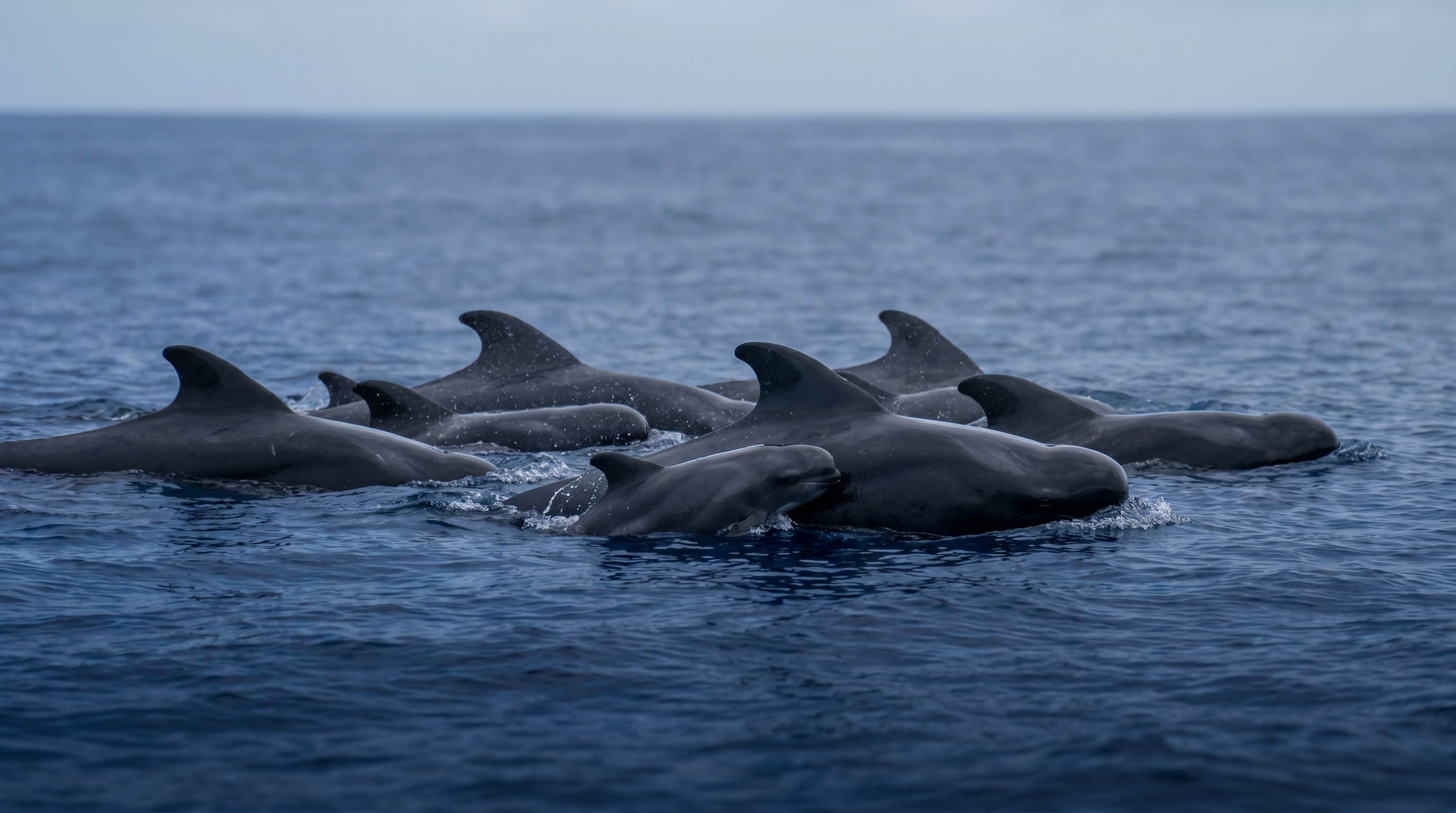
Distinguished from the Long-finned Pilot Whale by its shorter pectoral fins (less than 19% of body length vs. 25% in the Long-finned), slightly different melon shape, and warmer-water distribution. Otherwise very similar in appearance — predominantly black with a grey saddle patch behind the dorsal fin and a pale anchor-shaped chest patch.
Exceptional echolocation for deep-water squid hunting. Regular dives to 1,000–1,800 feet, with documented dives to 3,000 feet. Can hold breath for 15–20 minutes.
Highly vocal and socially complex. Produces whistles, clicks, and burst-pulse sounds. Hawaiian populations have been extensively studied — long-term social bonds between specific individuals are well-documented, with some associations maintained for 15+ years.
Deep-diving squid hunters. Most feeding is nocturnal, following squid as they rise in the water column. Highly cooperative — pods hunt together and share squid among members. The social structure of the pod means all members benefit from successful hunts by any individual.
Gestation
15 months. Females give birth every 5–8 years. Females undergo menopause at approximately 35–40 years and can live decades beyond.
Birth
Calves are approximately 5.5 feet long and 130 lbs at birth.
Calves
Calves nurse for 2+ years. Post-reproductive females are key caregivers for young pod members — grandmother effect extensively documented in Hawaiian populations.
Females reach sexual maturity at approximately 9 years; males at 13–16 years. Males rarely achieve breeding success before age 20 due to social competition.
Lives in stable, matrilineal pods of 15–30 individuals. Multiple related pods share overlapping ranges. Hawaiian populations have been observed in long-term stable groupings persisting for decades — some of the most thoroughly documented social structures among cetaceans.
Capable of 18 mph in short bursts. Occasionally breaches. Known for extended periods of "logging" — resting motionless at the surface in tight groups, sometimes for hours.
Short-finned Pilot Whales are one of only three non-human mammals known to undergo menopause — the others being Orcas and Humans. Post-reproductive females play essential roles in transmitting ecological knowledge to younger pod members — their experience with squid migration patterns significantly improves pod foraging success.
60–65 years for females; 45 years for males. Threats include drive hunts in Japan, longline and drift net bycatch, organochlorine contamination (PCBs, DDT), and acoustic disturbance from military sonar.
Dolphin Store