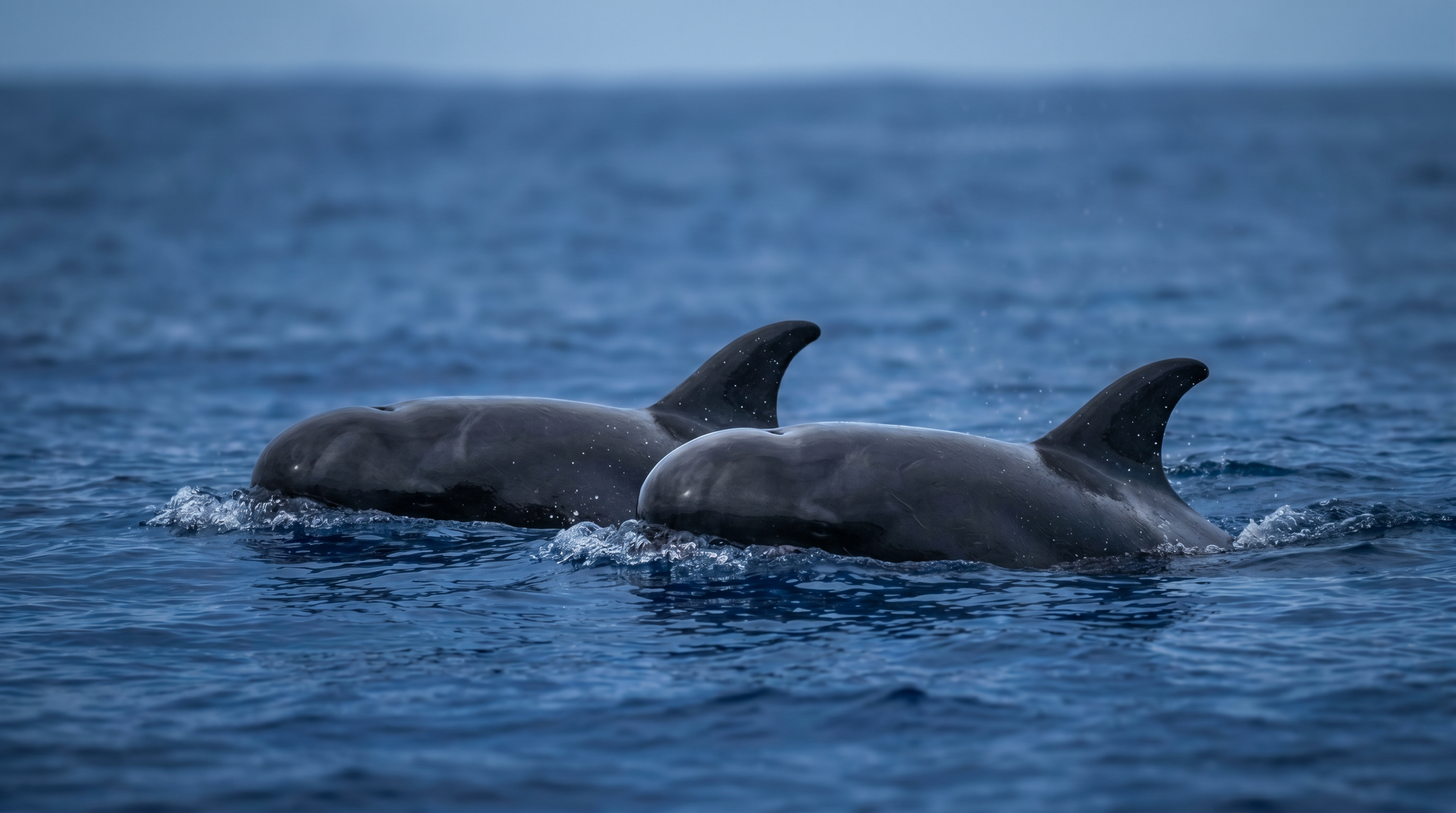
One of the rarest and least-studied of all dolphins — fewer than 50 scientific reports of wild Pygmy Killer Whales existed before 2000. Dark grey to black overall with a pale grey cape on the back and a white belly patch. The head is rounded with no beak — similar to the Melon-headed Whale but with a dark face mask and white "lips" at the mouth corners. Often confused with False Killer Whales, Melon-headed Whales, and Short-finned Pilot Whales.
Well-developed echolocation suited to deep tropical ocean. Very little is known about the specifics of their sensory biology.
Very little documented. Known to produce clicks and whistles from stranded specimens and rare at-sea encounters. Known to be aggressive at times — they are one of the few dolphins that will attempt to bite or charge researchers approaching too closely.
Feeds primarily on squid and fish, and has been documented attacking smaller dolphin species. Exact hunting strategies are largely unknown due to the rarity of observation.
Gestation
Approximately 11 months estimated. Reproductive data largely unknown.
Birth
Estimated at 31–35 inches and 20–25 lbs at birth.
Calves
Almost no data available from wild observations.
Estimated at 6–10 years based on skeletal maturity of stranded animals.
Found in groups of 12–50 individuals. Groups are tightly cohesive — when one animal is in distress, others rally around it (epimeletic behavior). This has contributed to multiple strandings where entire groups strand because they refuse to leave a distressed group member.
Active and capable swimmers. Known to approach vessels but can be aggressive and are not typically reliable bow-riders. Can swim at 15+ mph.
Pygmy Killer Whales are notoriously aggressive for their size — known to attack and kill smaller dolphins, and to behave aggressively toward researchers. They have a habit of 'logging' (floating motionless at the surface in tight groups) for extended periods that can last hours.
Estimated at 20–25 years. Threats include bycatch in tuna longlines and drift nets, prey depletion, marine pollution, and acoustic disturbance.
Dolphin Store