← All Species
Peponocephala electra
Melon-headed Whale
Least Concern
Also known as: Electra Dolphin +1 more
Peponocephala electra
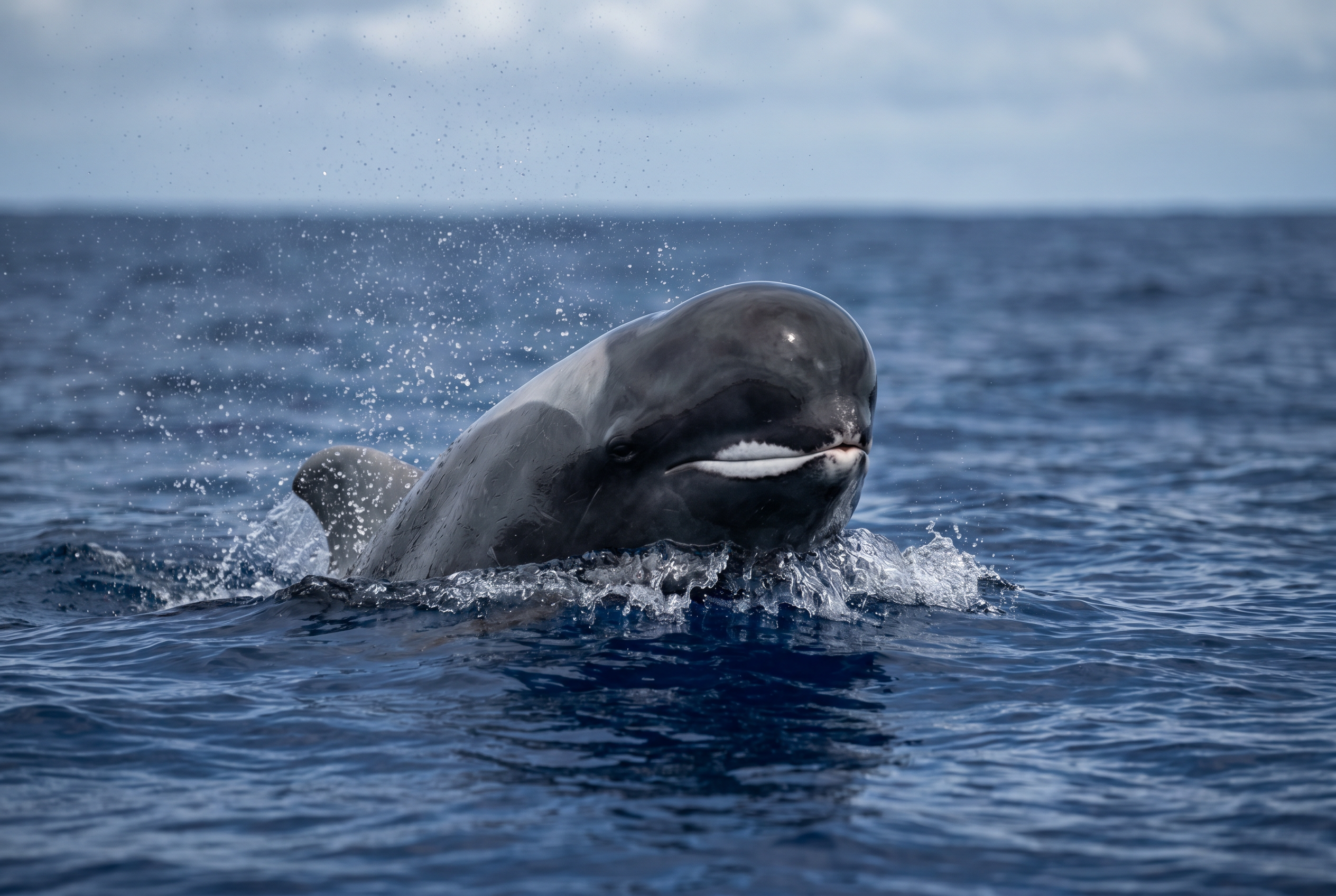
The Melon-headed Whale is named for its distinctive conical, melon-shaped head — it has almost no beak. Dark grey to black overall, with a slightly paler grey cape on the back and a narrow white "moustache" on the upper lip, white to pink belly, and dark face mask. It is often confused with the Pygmy Killer Whale and the False Killer Whale, though all three are distinguishable with practice.
Well-developed echolocation suited to the deep tropical ocean. Hearing adapted to locating squid in the water column at depths of 600+ feet.
Highly gregarious and vocal. Produces whistles, clicks, and burst-pulse vocalizations. Large groups are acoustically very active — the social calls of a large Melon-headed Whale school can be detected from great distances.
Deep divers — feeding primarily on squid and small fish in the mesopelagic zone. Hunts cooperatively in large, cohesive groups. Often observed "roiling" — churning at the surface in a tightly packed mass — possibly after cooperative feeding events.
Gestation
Approximately 12 months. Reproductive rate estimated every 2–3 years.
Birth
Calves estimated at approximately 40 inches and 33 lbs at birth.
Calves
Nursing estimated at 12–18 months. Calves travel in the protective interior of the large school.
Estimated at 6–10 years for females; 8–12 years for males.
One of the most gregarious of all cetaceans — typically found in schools of 100–1,500 individuals. These enormous schools are tightly packed and highly coordinated. The species regularly associates with Fraser's Dolphins, Spinner Dolphins, and short-finned pilot whales.
Fast swimmers capable of 18+ mph. Frequently bow-rides. Known for spectacular "roiling" behavior — entire schools churning at the surface.
In 2004, approximately 150–200 Melon-headed Whales entered Hanalei Bay in Hawaii and refused to leave for a day and a half. Research subsequently linked this to the military's use of mid-frequency active sonar in the area — one of the most well-documented cases linking sonar to cetacean behavioral disruption.
Estimated 20–30 years. Threats include bycatch in tuna longlines and drift nets, direct hunting in Japan and some Pacific island nations, and acoustic disturbance from military sonar exercises.
Dolphin Store