← All Species
Globicephala melas
Long-finned Pilot Whale
Least Concern
Also known as: Atlantic Pilot Whale +2 more
Globicephala melas
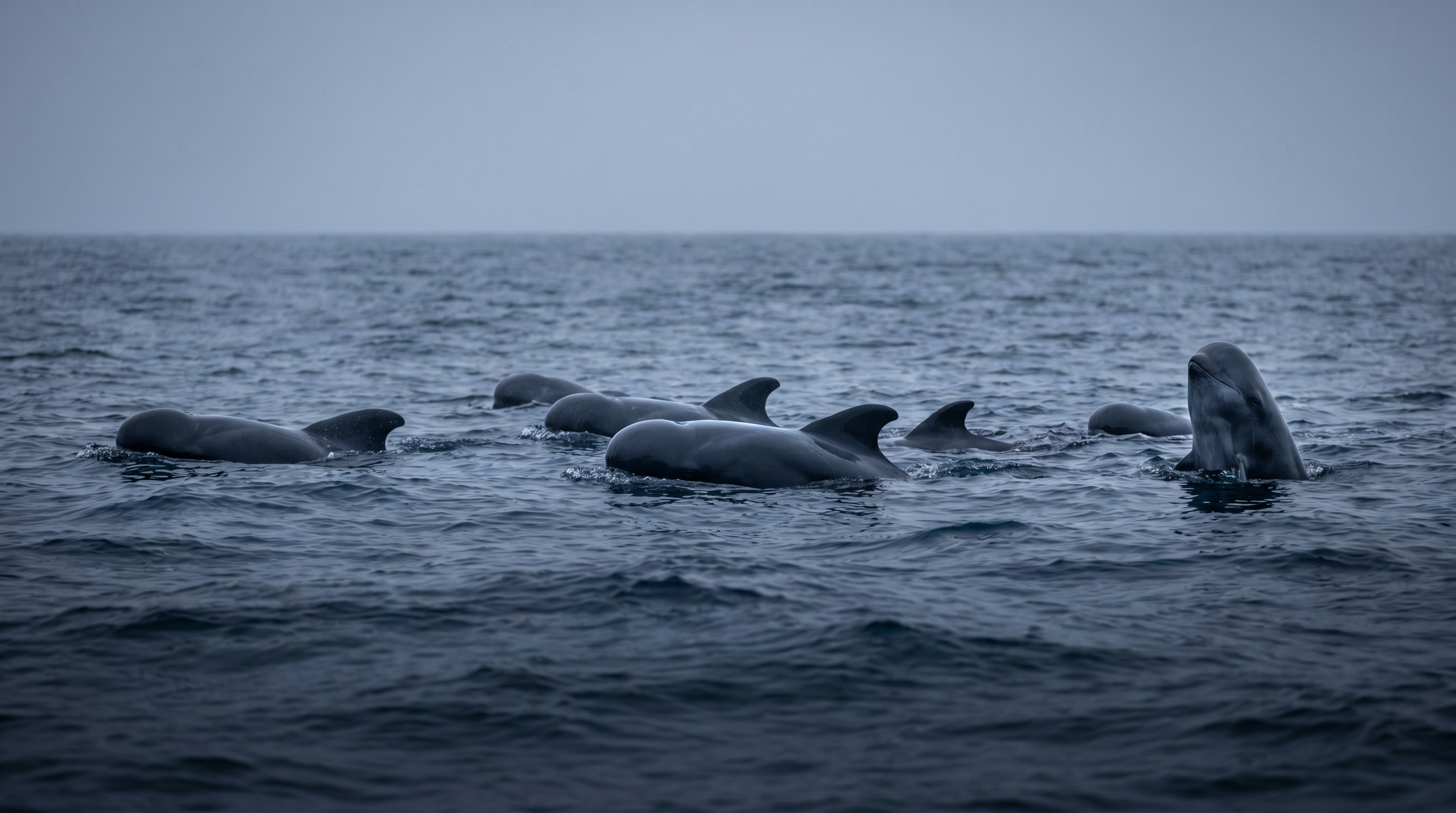
A large, robustly built dolphin — second in size only to the Orca among delphinids. The Long-finned Pilot Whale has a bulbous, rounded melon, very long curved pectoral fins (up to 25% of body length — distinctive from the Short-finned Pilot Whale), and is predominantly black with a grey saddle patch behind the dorsal fin and an anchor-shaped white patch on the belly.
Exceptional echolocation for deep-water squid hunting. Dive to 600–1,800 feet, holding their breath for 10–16 minutes. Hearing range extends to approximately 45 kHz.
Highly vocal and socially complex. Long-finned Pilot Whales produce clicks, burst-pulse sounds, and complex whistles. Social bonds are maintained through vocalizations across great distances. Pods have recognizable group-specific vocal signatures.
Deep-diving squid hunters — most feeding occurs at depths of 600–1,800 feet at night. Occasionally take fish. Highly cooperative hunters — pods coordinate to locate and herd squid aggregations. Can dive deeper than 3,000 feet in some documented cases.
Gestation
15–16 months. Females give birth every 5–8 years. Females undergo menopause at approximately 40 years and may live 20–30 years beyond.
Birth
Calves are approximately 6 feet long and 165 lbs at birth.
Calves
Calves nurse for 2+ years. Post-reproductive females provide significant care for calves of younger pod members — grandmother effect well-documented.
Females reach sexual maturity at 6–7 years; males at 12–14 years. Males rarely achieve breeding success until their late teens due to competition.
One of the most socially cohesive cetaceans — pods of 10–50 form stable, long-term matrilineal groups. Individuals rarely permanently leave the pod. Mass strandings (involving entire pods following a disoriented leader) are more frequent in this species than almost any other cetacean.
Capable of impressive speed — 25 mph in short bursts — despite their large size. Breaching and spy-hopping observed. The exceptionally long pectoral fins provide excellent maneuverability for deep-diving pursuits of squid.
In the Faroe Islands, Long-finned Pilot Whales are subject to traditional drive hunts (Grindadráp) — the most controversial cetacean hunt in the world. Hundreds of pilot whales are driven ashore and killed each year in a practice dating back over 1,000 years. The hunt remains highly controversial internationally.
45–60 years for females; 35–45 for males. Primary threats include Faroese drive hunts, longline and drift net bycatch, organochlorine contamination (particularly PCBs), and acoustic disturbance from military sonar.
Dolphin Store